
While I think very highly of many of the DSLR cameras that The new Pentax K-3 is very different. Significantly, the The new sensor lacks an anti-aliasing filter, which For the Pentax DSLR user, the increased resolution alone I look forward to testing the full capabilities of the Thanks to the K-3′s built-in sensor-based image One of the things we like about Pentax DSLRs is their Also making the K-3 attractive to demanding In the hand, the K-3 feels tough and strong. It has a Like other recent Pentax DSLR cameras, the K-3 has a The build quality and the features listed so far already The K-3 has a dual SD card slot for storing images and The Pentax K-3 is also compatible with standard Eye-Fi cards Pentax now has a full line-up of DLSR cameras, from the If the resolution and image quality match what we have The Pentax K-3 will be available in November, priced See product shots of the Pentax K-3 Pentax K-3 at a glance:
Pentax K-3 – Introduction
Pentax has released over the past few years, they have sometimes been hard to
distinguish from others. All have been excellent in their own right, but often there
has been little variation or any real standout features that would warrant
existing Pentax users upgrading to a new DSLR.
camera uses a Sony 24.3-million-pixel CMOS sensor, which is presumably the same
sensor as that used in a number of other popular cameras, including the Sony
NEX-7 and Alpha 77. The 24.3-million-pixel resolution is a big increase from
the last four Pentax DSLR cameras – the K-5, K-30, K5 II and K5 IIS – which are
all 16-million-pixel models.
means it has even greater resolving power than expected from a 24-million-pixel
sensor. For some users moiré patterning may be a concern, but Pentax has
developed an ingenious anti-aliasing effect by utilising the on-sensor image
stabilisation. When activated, the sensor moves during the exposure – not by
much, but just enough to blur the image by a pixel or two, which the company
claims produces the same effect as an anti-aliasing filter.
is probably enough to warrant an upgrade, but the K-3 has so much more to it
than an improved sensor. It also has the potential to be a camera that can take
on, and beat, the dominance of Canon and Nikon.Pentax K-3 – Key features
K-3′s 24.3-million-pixel sensor, particularly how much detail it can resolve and
whether the anti-aliasing sensor’s shift feature works in real-world tests.
With a maximum sensitivity of ISO 51,200, 14-bit raw capture and a very
impressive 8.5fps shooting rate, enthusiast photographers are well catered for.
stabilisation, all lenses used on the K-3 are stabilised, regardless of whether
they are brand new or a 30-year-old manual-focus K-mount lens. The AF system is
another new feature. The system now has 27 AF points, 25 of which are cross-type.
The centre points are sensitive down to f/2.8, which allows for better focusing
speed and accuracy in low light with f/2.8 lenses. Although the number of AF
points may pale a little in comparison to the 51-point system that Nikon has
employed in its cameras for a number of years, 27 points should be more than
enough for most photographers, particularly as the key audience for the Pentax
K-3 isn’t going to be professional sports photographers. Pentax K-3 – Build quality
rugged nature. The Pentax K-3 is no exception, as it has a fully weather-sealed
magnesium-alloy body. More importantly, the range of Pentax WR (weather-resistant)
lenses is growing, and the K-3 can be bought with a variety of weather-sealed
lenses, including the standard 18-55mm f/3.5-5.6 WR kit lens. A weather-sealed
battery grip and two weather-sealed flashguns are also available.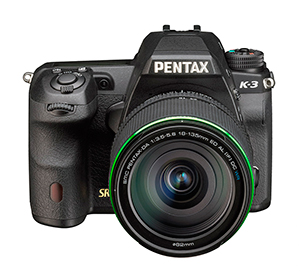
photographers is the durability of the shutter, which has been tested up to 200,000
actuations. This will be particularly appealing for those photographers keen to
take advantage of the K-3′s ability to create time-lapse videos at a 4K
resolution – and just in time for the new 4K high-definition televisions that have
arrived in shops recently.Â
reassuring weight to it, without being overly large and heavy. All the buttons
are in logical places, and the camera should feel familiar to most DSLR
photographers, not just Pentax users
100% optical viewfinder and an equally impressive screen. The 3.2in, 1,037,000-dot
screen is gapless, meaning there is no air between the screen and the
protective glass on the rear of the camera. The result is a screen that has reduced
reflection, and one that is bright, with rich colours and a good range of
contrast. It looked stunning in the pre-production sample of the camera that we
saw.
make the K-3 appealing, but there are many more to entice those who may be
tempted to switch to Pentax from Canon or Nikon.Pentax K-3 – Data and connectivity
to enable Pentax Flucards to be used. These SD-compatible cards essentially
give the Pentax K-3 Wi-Fi connectivity. Unlike Eye-Fi cards, which only offer
image transfer, Flucards allow for full control of the camera’s exposure
settings and focusing, as well as a mirrored live view display. The final
specification of what will be compatible with the Flucards has yet to be
finalised, although Android and iOS should both be supported. The images we saw
of a device operating the K-3 also showed a web-browser window, suggesting that
remote control via a web-based interface may be possible, although this will
most likely be via an ad hoc connection rather than being able to control the
camera from anywhere in the world via a computer.
for those who just want to copy images via Wi-Fi. Getting images off the camera
in a more conventional manner is made faster with the addition of a USB port on
the side.Pentax K-3 – First impressions
K-50 and K-500, to the K-5 II and K-5 II S, with the new K-3 increasing its
range. Yet what is different is that the K-3 offers a real alternative, not
only in terms of resolution, but also in its feature set, which wouldn’t look
out of place on a professional DSLR camera.
seen from other cameras containing the Sony sensor, the K-3 could be a real
prospect for Pentax. It could help rebuild its DSLR brand, and provide a rival
for the ‘big two’ manufacturers by competing with them on the same level. I’m
really looking forward to testing this camera in the next couple of months.
£1,099.99 body only.
Pentax K-3 hands-on review

No comments:
Post a Comment